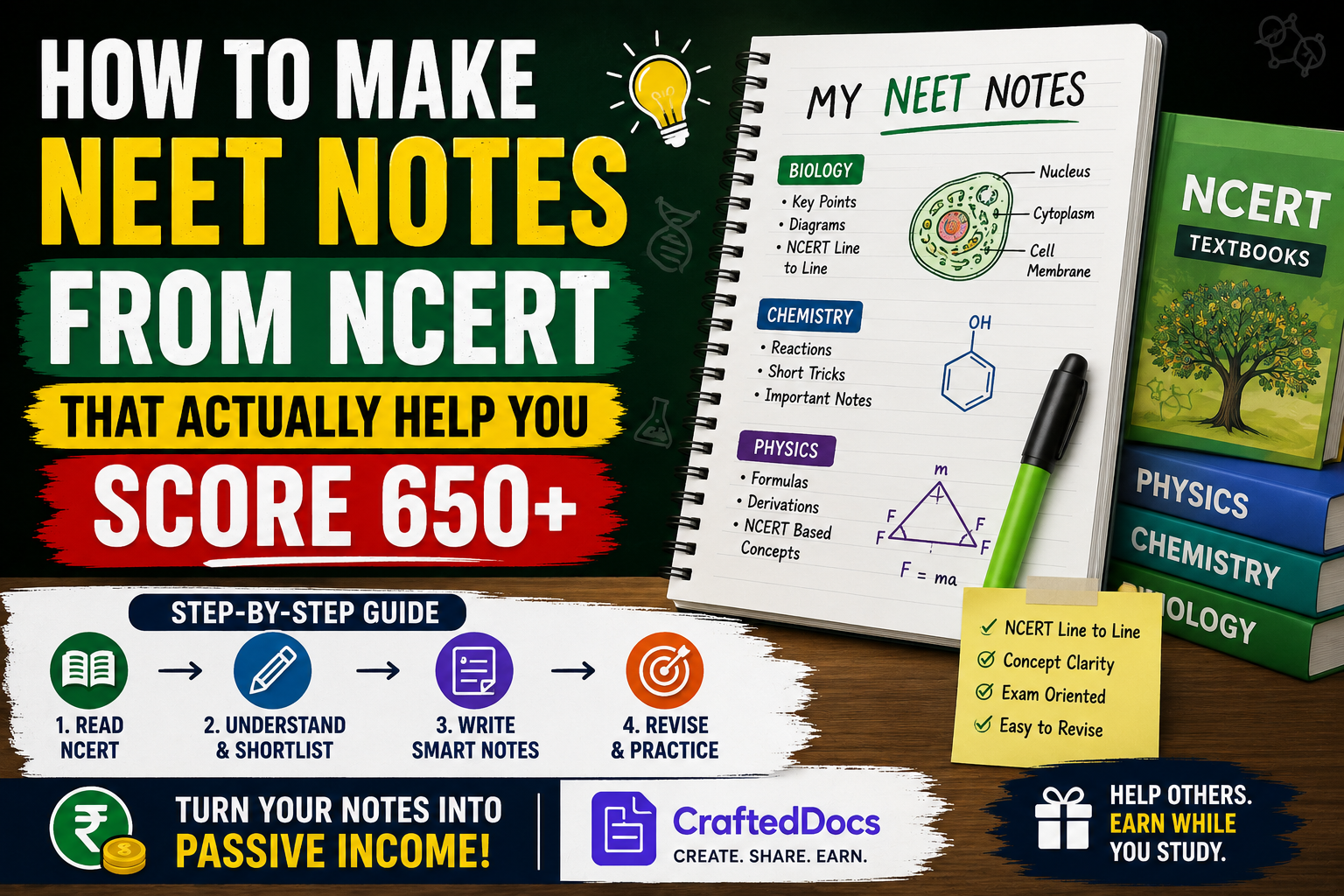
Every NEET teacher says the same thing: "NCERT is the Bible for NEET." And they're right — nearly 80–85% of NEET Biology questions come directly from NCERT. But reading NCERT is only half the job. The other half is making notes that let you revise fast and retain more.
In this guide, we break down exactly how to make NEET notes from NCERT that are actually useful — not just a copy-paste of the textbook. And at the end, we'll show you how to turn those notes into a source of income by selling them on CraftedDocs.
Why Most NEET Students Make Bad Notes
Most students make one of these mistakes when taking notes from NCERT:
- Copying entire paragraphs — this is not note-making, it's transcription. It wastes time and doesn't help retention.
- Skipping diagrams — NEET Biology has 5–10 diagram-based questions every year. Notes without diagrams are incomplete.
- No prioritisation — treating every line of NCERT equally when some chapters carry 3x more marks than others.
- No revision structure — notes that are great for making but impossible to revise quickly in the last 30 days before the exam.
The goal of good NEET notes is simple: read NCERT once deeply, make notes that let you revise in 10% of the time.
Step-by-Step: How to Make NEET Notes from NCERT
Step 1: Read the Chapter First — Don't Take Notes Yet
Read the full NCERT chapter once without writing anything. This gives you the big picture and helps you understand what's important before you start filtering. Most students skip this and end up noting everything.
Step 2: Identify High-Yield Content
On your second read, mark sentences and facts that are:
- Definitions (NEET loves definition-based MCQs)
- Names, numbers, and classifications (e.g., number of bones, hormone names, enzyme names)
- Processes with sequences or steps (e.g., Calvin cycle, meiosis stages)
- Diagrams and their labelled parts
- Anything NCERT puts in bold — it's bold for a reason
Cross-reference with previous year NEET questions (PYQs) for the chapter. Any concept that appeared in PYQs multiple times is guaranteed high-yield content — mark it with a star in your notes.
Step 3: Use a Consistent Note Format
Good NEET notes follow a consistent structure for every chapter. Here's a format that works:
| Section | What to Include |
|---|---|
| Chapter Overview | 3–5 bullet points summarising the chapter theme |
| Key Definitions | All definitions from the chapter in your own words |
| Important Diagrams | Redrawn diagrams with all labels — no shortcuts |
| Processes and Steps | Numbered steps for any biological process |
| Numbers and Facts | All specific numbers, names, and classifications |
| PYQ Flags | Mark any concept that appeared in past NEET papers |
Step 4: Write in Your Own Words
Never copy NCERT sentences word-for-word into your notes. Rewriting in your own language forces your brain to process and understand — not just transcribe. Your notes should be shorter and simpler than the textbook, not a mirror of it.
Step 5: Add Mnemonics and Memory Tricks
For lists, sequences, and classifications — create a mnemonic or shortcut right in your notes. For example:
- Taxonomic hierarchy: "King Philip Came Over For Good Soup" (Kingdom, Phylum, Class, Order, Family, Genus, Species)
- Enzyme-substrate specificity facts as a colour-coded table
- Flowcharts for hormonal feedback loops
Step 6: Leave Space for Revision Additions
Good notes are living documents. Leave margins or blank sections where you can add things later — new PYQs, corrections from mock tests, or concepts you forgot the first time.
A4 size paper with 3 columns works well for NEET notes: main content in the centre, key terms on the left margin, and revision additions on the right margin. This keeps everything organised and scannable.
Which NCERT Chapters Should You Prioritise First?
| Subject | Top Priority Chapters |
|---|---|
| Biology (Botany) | Plant Physiology, Reproduction in Plants, Ecology |
| Biology (Zoology) | Human Physiology, Genetics, Evolution |
| Physics | Optics, Electrostatics, Modern Physics, Mechanics |
| Chemistry | Organic Reactions, Coordination Compounds, Chemical Bonding |
Short on Time? Download Ready-Made Notes from CraftedDocs
Making notes from scratch takes weeks — sometimes months. If you're in your final revision phase or just need notes for specific chapters, you can download ready-made NEET notes from real students and toppers on CraftedDocs.
- Chapter-wise handwritten and typed PDFs
- Free preview before every purchase
- Verified sellers with student credentials
- Prices starting at ₹29 — much cheaper than any coaching material
- Instant download — no waiting, no expired links
Sell Your NCERT Notes and Earn Passively
If you've put in the work to make great NEET notes from NCERT, other students are actively looking for exactly what you've made. You can sell your notes on CraftedDocs and earn while you sleep.
- Scan or export your notes as a PDF
- Sign up as a seller at crafteddocs.com — it's free
- Upload chapter-wise or subject-wise bundles
- Set your price and upload a free preview
- Earn 80% of every sale paid directly to your UPI
Notes that are most popular on CraftedDocs are chapter-wise (not full subject dumps), include diagrams, and have a clear listing title with the chapter name. Make it easy for buyers to find exactly what they need.
Frequently Asked Questions
Is NCERT enough to score 650+ in NEET?
For Biology, NCERT is the most critical resource — most toppers credit NCERT as the foundation of their 650+ scores. For Physics and Chemistry, NCERT is necessary but needs to be supplemented with problem-solving practice.
How long does it take to make notes for all NCERT Biology chapters?
If you dedicate 2–3 hours per chapter, making notes for all NEET Biology chapters typically takes 4–6 weeks. This is why many students download ready-made notes for their weaker chapters to save time.
Should I type my NEET notes or write them by hand?
Both work, but handwritten notes tend to improve retention for most students. Typed notes are faster to make and easier to share. Many students do a mix — typed for Chemistry and Physics, handwritten for Biology.
Can I sell notes I made from NCERT on CraftedDocs?
Yes, as long as the notes are your own original work. Writing notes in your own words from NCERT creates new original content that you can sell. You cannot, however, scan and sell NCERT textbook pages directly — that would be copyright infringement.
How do I price my NEET notes on CraftedDocs?
A good starting range is ₹49–₹149 per chapter or ₹199–₹499 for a full subject bundle. Check what similar sellers are charging on the platform and price competitively. You can always run coupon codes to attract your first buyers.
India's student-first marketplace for NEET notes, formula sheets, and study material. Download instantly or earn 80% by selling yours.
Start on CraftedDocs →